
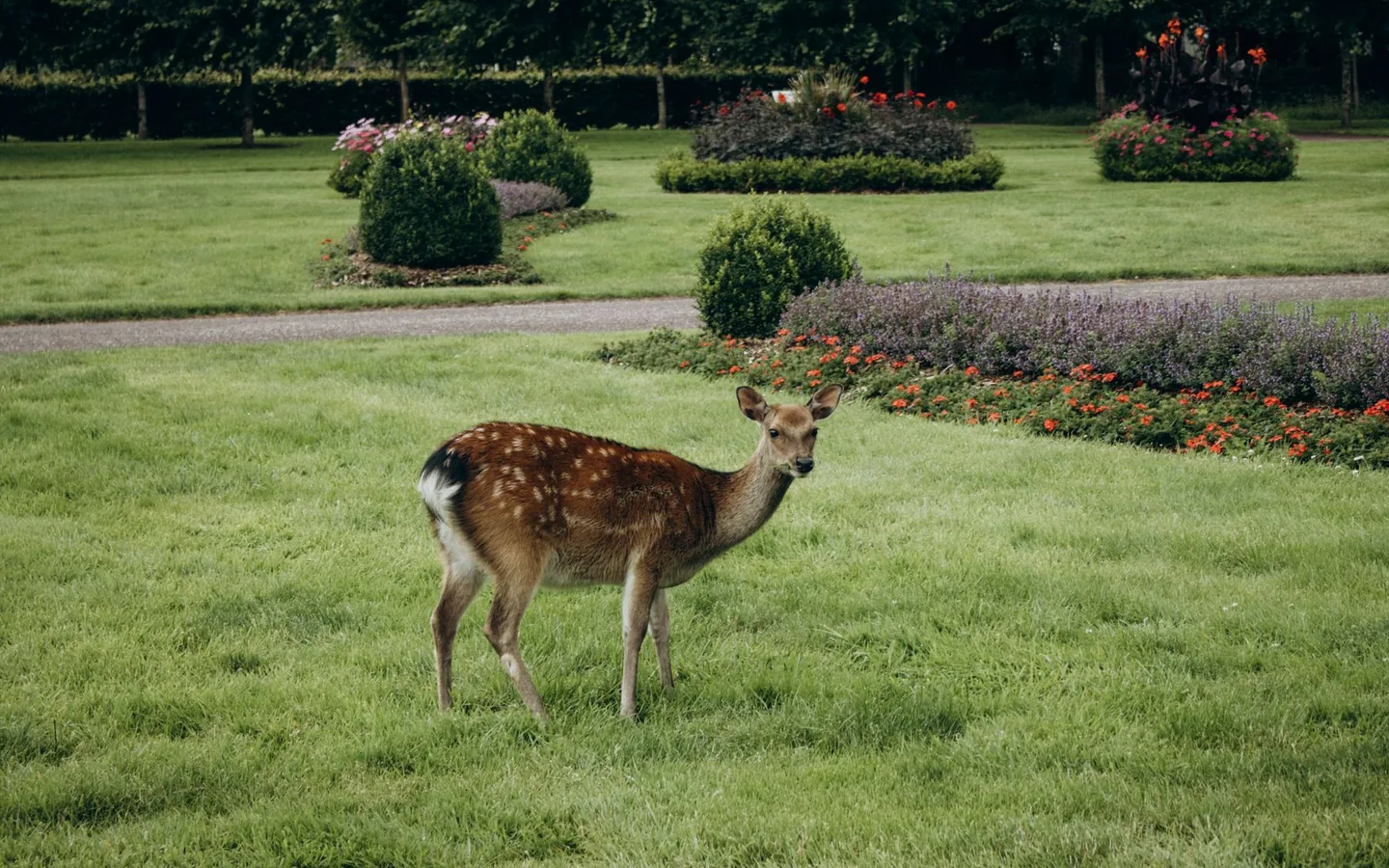
A deer visiting a garden can strip tender rose shoots or young trees in a single night. In some areas the damage is occasional; elsewhere deer return repeatedly and may also rub their antlers against the bark of saplings.
The most dependable protection is physical exclusion, particularly for valuable new planting. Scent repellents and supposedly deer-proof plant lists are much less reliable when animals are hungry.
How do you know deer are responsible?
Look for new shoots bitten off at reachable height, damaged flowers and bark rubbed from thin young trunks.
Deer do not have the same upper front teeth as many grazing animals, so browsed twigs can look torn or ragged rather than neatly cut.
Check for hoofprints and repeated damage along a route from nearby woodland or fields. Rabbits, hares and other animals can cause similar damage lower down, so don't build a huge deer fence before confirming the cause.
Which deer visit UK gardens?
Roe, muntjac, fallow and red deer can occur in different parts of the UK, with varying body size and behaviour.
Smaller muntjac may push through low gaps and feed among shrubs, while larger deer may reach higher foliage or jump obstacles.
Fence design should suit the species actually visiting your property. A barrier that stops one species may be inadequate for another.
Fencing is the most reliable long-term answer
The RHS advises robust deer-proof fencing around 1.5m high for muntjac and 1.8m for other deer, with suitable heavy-duty lower mesh and a secure bottom edge.
These are practical guidance figures, not a guarantee that no deer could ever jump or force its way through a particular fence.
The gates and gaps matter as much as overall height. A strong tall fence with a large gap at its base is ineffective against animals able to squeeze underneath.
Check local planning restrictions, boundaries and any rights of way before erecting a tall garden fence.
Netting for individual beds
If fencing an entire garden is impractical, protect the most valuable plants first.
A properly constructed fruit cage or mesh enclosure can exclude deer from a vegetable bed. Use strong supports, a secure gate or access opening and material that deer cannot easily push through.
Keep netting taut and clearly visible to reduce entanglement risks for deer, birds and other wildlife. Avoid leaving loose mesh draped over shrubs.
Inspect enclosures after wind and storms, repairing holes before animals discover them.
How to protect young trees
Young trees are vulnerable both to browsing and to antler rubbing.
Use a robust tree guard or protective cage sized to suit the likely deer species. Position stakes far enough from the trunk so a deer cannot reach the bark by leaning between them.
Check guards regularly: ties and mesh can rub the growing trunk if left neglected. Remove or adjust protection as the tree matures, without exposing it too early.
A tree with heavily stripped bark may suffer serious long-term damage even if it still has green leaves.
For a new row of trees, our tree spacing calculator can help plan layout without overcrowding the growing crowns.
What about commercial deer repellents?
Some repellents discourage deer temporarily through taste or smell, but performance varies with weather, new plant growth and local feeding pressure.
Repellents often require repeat applications after rain and during active growth. If you use one, follow its current label and avoid inappropriate products on edible crops.
Don't rely on scent alone for expensive newly planted trees where deer visit every night.
Plants deer are less likely to eat
No plant is guaranteed deer-proof. Deer sometimes browse species they normally avoid when food is scarce.
Nonetheless, many gardeners report less feeding on tough, aromatic, coarse or prickly plants.
| Plant type | Examples to consider | Limitations |
|---|---|---|
| Strongly scented foliage | Lavender, some rosemary and sage | Not all hardy in every site; no guarantee |
| Tough evergreen structure | Some holly and other dense shrubs | Young shoots may still be eaten |
| Ornamental grasses | Various species | Tender new growth can attract feeding |
| Certain perennials | Foxgloves, hellebores, some euphorbias | Some are poisonous; suitable site and safety matter |
| Thorny hedges | Hawthorn and suitable roses | Young growth can still be browsed |
Choose plants that suit soil and light, rather than treating deer resistance as the only requirement.
A temporary plan for new planting
When establishing a vulnerable border, protect seedlings and young shrubs individually until the planting is strong.
A small rigid wire cage around each particularly valuable plant may be a practical temporary measure if it does not restrict growth.
Check that the guard won't trap birds or catch animal limbs and that access remains safe for children and pets.
Temporary fencing is most useful when combined with a broader plan, since deer may simply switch to another unprotected bed.
Vegetable gardens and fruit
Deer can eat brassicas, peas, beans, salad leaves and fruit-tree shoots. Fine insect mesh designed for butterflies is usually not strong enough on its own to resist a large deer.
For repeated visits, protect a whole bed with a rigid fence or cage of suitable height and strength.
Keep edible crops accessible for watering and harvesting without leaving the enclosure door open overnight.
Will a hedge stop deer?
A sufficiently high and dense hedge can form an effective barrier in some gardens, especially when supported by fencing during establishment.
But a sparse newly planted hedge has gaps, and deer may feed on its young shoots before it thickens.
Choose mature size, density and species carefully. Our hedge spacing guide helps plan an appropriate planting pattern.
Safety around roads and public paths
Don't place loose fencing, wire or netting where wildlife could become trapped near a public right of way or roadway.
If fencing a boundary beside a highway, check sightlines and legal requirements. A tall screen may hide emerging vehicles or pedestrians.
Never attach hazardous deterrents to a public-access fence. For severe problems near roads, seek local professional advice.
Common deer-protection mistakes
- Relying on a “deer-proof” plant label.
- Building a tall fence but leaving gaps beneath gates.
- Using loose netting that can entangle wildlife.
- Protecting leaves while leaving young tree bark exposed to rubbing.
- Expecting a scented spray to protect expensive new planting indefinitely.
- Installing fencing without checking property and planning restrictions.
A sensible action plan
First identify the animal and typical entry route. Protect your most valuable plants with safe sturdy guards, then consider whether a continuous boundary is justified.
Use less attractive planting as a supporting measure, not your entire strategy.
How high should a deer fence be in the UK?
RHS guidance suggests about 1.5m for muntjac and 1.8m for other deer, with appropriate mesh and secured lower edges. Site conditions may demand more.
Can deer eat roses?
Yes. Tender rose shoots and flower buds are commonly browsed, even where the plant has thorns.
Do ultrasonic deer deterrents work?
Evidence for reliable protection is limited. For valuable crops, physical exclusion is the safer primary strategy.