
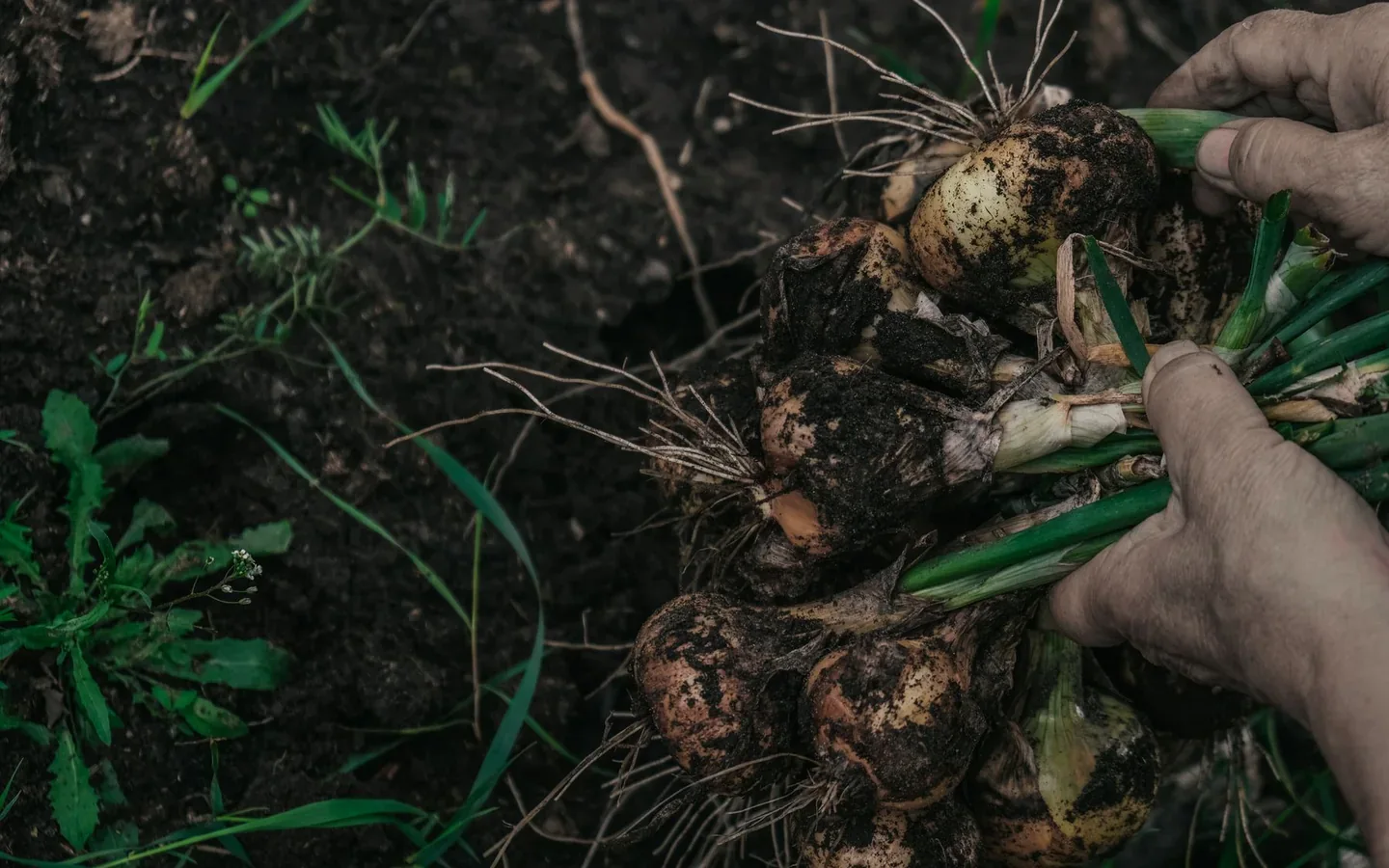
Onion sets are small immature bulbs sold for planting. Instead of raising onions from tiny seeds, you put a set directly into the soil and let it make a full-sized bulb during the season.
They are often the easiest way to begin growing onions in a UK garden. Yet good results still depend on planting depth, spacing and sensible watering, rather than simply pressing sets into any piece of ground.
What are onion sets?
A set is a small onion bulb grown the previous season and kept dormant for planting. It already contains the growing point for roots and leaves.
Sets establish more quickly than onion seeds and are convenient for small plots, although seed-grown onions give a wider choice of varieties.
You can buy white, yellow or red onion sets, plus specific cultivars bred for overwintering. Check the packet because they are not all planted at the same time.
Do not confuse onion sets with spring onions, which are normally grown for young leafy stems rather than a large dry storage bulb.
Spring sets versus autumn sets
| Type | Planting period | Typical harvest |
|---|---|---|
| Spring-planted onion sets | March–April in workable soil | July–September |
| Overwintering onion sets | September–October, variety permitting | June–July the following year |
Dates vary with local conditions. An exposed northern garden with saturated soil may need to plant spring sets later than a sheltered southern plot.
Spring sets are the focus here. For varieties grown over winter, see our overwintering onion guide.
Don't use a spring-only cultivar as an autumn set simply because it was discounted at the garden centre.
Choose the right position
Onions prefer full sun and soil that drains well. They dislike heavy persistent waterlogging, especially while young roots are establishing.
Remove weeds before planting. Their leaves provide relatively little shade, so weeds can compete strongly for light, water and nutrients.
Work in mature compost if soil needs improvement, but avoid a thick layer of fresh manure directly beneath the sets.
If previous onions have rotted repeatedly, inspect drainage and crop rotation before adding more feed.
How deep should onion sets be planted?
The usual target is for the set to sit about 2cm deep with its pointed tip just visible at the soil surface.
Planting too deeply can slow establishment or encourage problems in heavy wet soil. Leaving most of the bulb sticking up makes it vulnerable to disturbance by birds.
To plant:
- Rake a prepared bed level and remove obvious stones.
- Mark rows roughly 20–30cm apart.
- Make shallow holes or a drill that lets each set sit with roots down and tip upward.
- Set bulbs approximately 10–15cm apart along the row.
- Replace and firm the soil so only the tip is showing.
- Water to settle the soil if it is dry.
- Label the variety and date.
A gently pressed set is enough. Don't crush it firmly into compacted clay with the heel of your boot.
How far apart should onions be?
For ordinary bulb onions, 10–15cm between sets is a useful starting range. Wider spacing gives larger individual bulbs where other growing conditions are good.
If you're happy with smaller onions, closer spacing may be possible, but crowding can create thinner, poorly formed bulbs.
A short row with good spacing is often more productive than a dense bed where no onion reaches useful size.
Our plant spacing guide helps fit onions around other vegetables without placing too many sets in the same space.
Can you plant onion sets in pots?
Yes. Choose a wide, reasonably deep container with drainage holes and a stable base. A trough can be particularly useful.
Fill with suitable peat-free compost and give each developing bulb enough room to swell.
Keep the pot in a sunny position and monitor water carefully, because containers dry faster than ground-grown beds.
Don't fill a narrow ornamental pot with ten sets and expect ten big onions. Use our pot compost calculator if you're planning a deep trough.
Watering onion sets correctly
Water after planting if the soil is dry. During growth, aim for steady moisture rather than long droughts followed by flooding.
Water thoroughly at root level in dry spells, particularly during active bulb development.
Onions usually need less routine watering as they mature and tops begin naturally dying back. Persistently wet mature bulbs are more likely to store poorly.
Avoid a fixed watering schedule when the weather is rainy. Check soil moisture first.
Should onions be fed?
Onions benefit from fertile soil but are not improved by constant heavy applications of nitrogen.
In a poor bed, a suitable general fertiliser applied according to instructions may help early growth. Once bulbs begin swelling, excessive high-nitrogen feeding can produce more leaves without improving storage quality.
A soil test is useful if crops have struggled for several seasons.
Don't assume every yellow leaf is a nutrient shortage. Natural leaf ageing, disease, drought and waterlogging can all contribute.
How to stop birds pulling up onion sets
Small sets planted with exposed tips may be lifted by birds or disturbed by small animals.
A temporary light fleece or secure bird-safe mesh can help during early establishment, provided it doesn't trap wildlife or crush new leaves.
Check the covers regularly and remove them when the roots are holding sets securely.
Replant any sound lifted sets promptly if they haven't dried out or been badly damaged.
Why do onions bolt?
Bolting is when the plant produces a flower stalk before you've harvested the storage bulb.
Temperature stress and the physiological condition of the sets can contribute. Sets bred and stored appropriately reduce the risk, but no variety eliminates it.
A bolted onion can still have useful edible flesh, yet it won't keep as well as an unbolted, fully cured storage onion.
Use bolted onions promptly rather than planning to hang them in a shed for months.
Should you break onion leaves to make bulbs bigger?
No. Healthy leaves are important for making the sugars that fill the bulb.
Don't fold or crush green foliage deliberately to force maturity. Let the tops begin to yellow and fall over naturally.
Removing large amounts of green leaf reduces the plant's ability to finish bulbing.
If a few leaves are damaged by wind, leave the remaining healthy foliage to carry on working.
When are spring onions ready to lift?
Spring-planted bulb onion sets often mature in summer, when leaves yellow and fall over and bulbs have developed their final size.
Check the variety and growing conditions. Not every row is ready on the same date.
Loosen soil with a garden fork and lift bulbs carefully rather than pulling forcefully on dry leaves.
Handle them gently: bruised onions may rot during storage.
Curing after harvest
Onions intended for storage need their outer skins to dry thoroughly. Lift during a dry period if practical and lay them in a warm, airy, sheltered place.
Curing time depends on weather and bulb size. Don't rush damp onions into a closed bag or box.
Once the neck and skins are properly dry, move sound bulbs into a cool, dry, well-ventilated storage area.
Keep damaged or bolted onions for early use. A wet, sealed container is not suitable for long-term onion storage.
Common problems
Sets rot before sprouting: cold saturated soil or damaged bulbs may be responsible.
Leaves have white patches or streaks: identify disease or pests rather than spraying without diagnosis.
Bulbs stay small: crowding, weeds, poor light and drought may contribute.
Onions flower early: bolting may have been triggered by stress or set condition.
Necks stay thick and wet: delay long-term storage and investigate late-season nitrogen and maturity.
Quick answers
Which way up do onion sets go? Root end down, pointed growing tip upwards.
Can I plant sets in February? Only if the variety and local ground conditions suit it; March–April is often safer for spring types.
Can onion sets grow in pots? Yes, with enough width and drainage for bulbs.
Are sets better than seed? They're easier and faster to establish; seeds give more variety and can be economical for larger plantings.
Good onions begin as properly planted sets in weed-free soil. Leave the leaves intact, keep moisture sensible and let the bulbs mature naturally before lifting.