
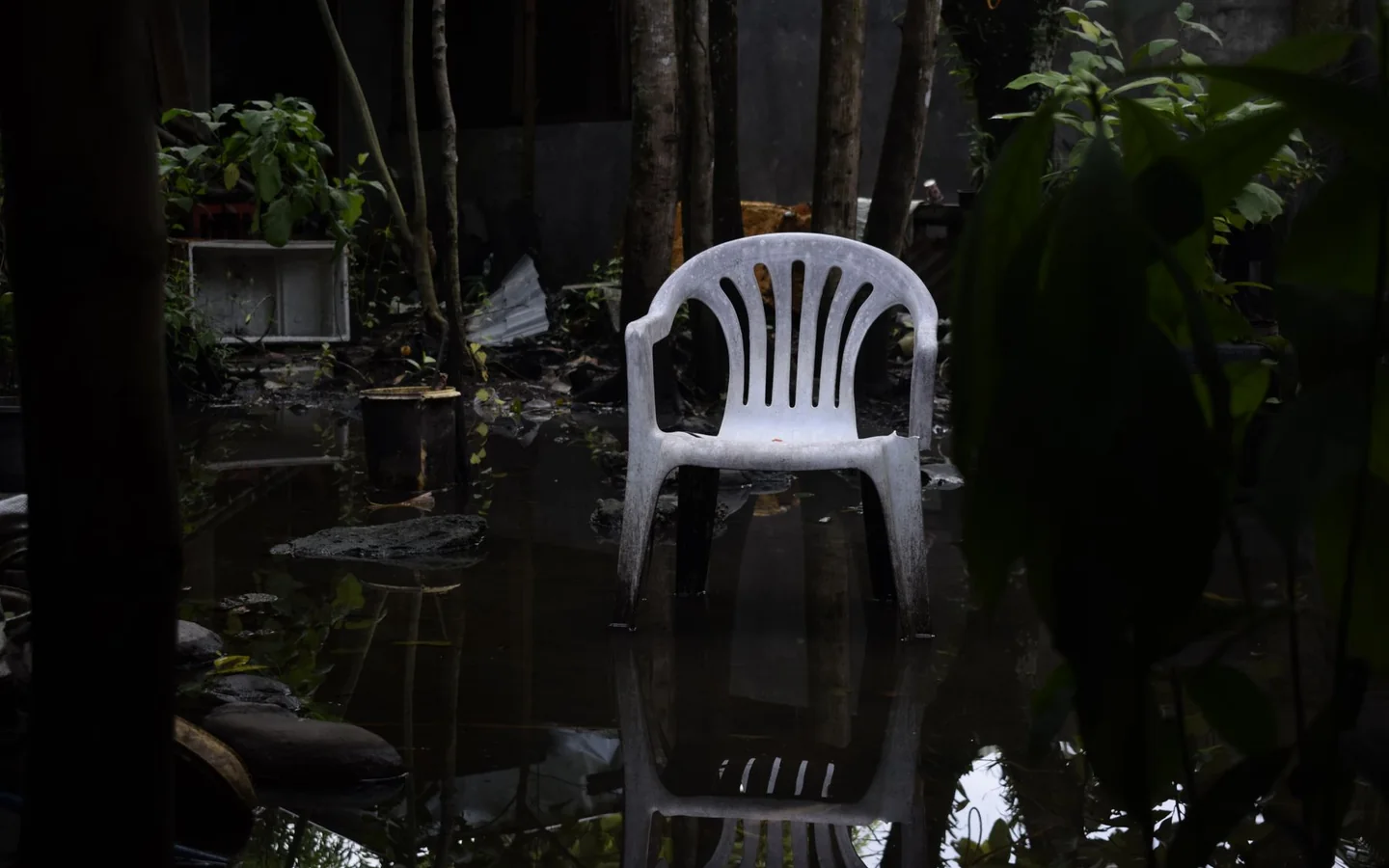
A lawn that holds puddles for days can lose grass, turn muddy underfoot and struggle to recover every spring. But digging a French drain straight away may be expensive and ineffective. The water might be coming from a blocked downpipe, a worn path, compacted building soil or the slope of a patio.
Work out where the water comes from and whether it has a safe outlet before changing the lawn. Good drainage moves water somewhere appropriate; it doesn't simply hide it under gravel.
Start with the pattern of waterlogging
Watch the lawn during and after heavy rain. Sketch the deepest puddles and note whether they form near paving, a fence line, a downpipe or a frequently used path.
A lawn with shallow puddles that disappear quickly may simply be temporarily saturated after unusual weather. Water that remains for days with no further rainfall deserves closer investigation.
Compare the worst areas with a part of the garden where grass is healthy. This helps identify local compaction and surface levels.
Common causes and first responses
| What you find | Possible cause | First useful step |
|---|---|---|
| Strip of mud along a walking route | Foot traffic on wet soil | Reduce traffic, consider a proper path |
| Water beside a patio edge | Surface runoff | Check paving levels and lawful discharge |
| Soggy area near a downpipe | Leak, overflow or blockage | Inspect gutters and downpipes |
| Whole clay lawn wet in winter | Slow infiltration or high groundwater | Assess soil profile and seasonal water table |
| One depression holds a puddle | Low ground level | Consider targeted levelling after drainage check |
| Grass thins but no standing water | Shade, roots or nutrient stress | Check whether drainage really is the problem |
Avoid treating every patchy lawn as a drainage failure. Some need more light, different grass or less wear rather than new pipes.
Check whether the soil is compacted
When the ground is moist but not saturated, try gently inserting a garden fork into the affected area and compare resistance with healthier ground.
Repeated foot traffic, construction machinery and working clay when wet can compress pore spaces. Air and water then struggle to move into the root zone.
If the lawn is strongly compacted, hollow-tine aeration may help by removing small soil cores. Solid-tine spiking can be less effective for heavy compaction because it pushes soil aside.
Do the work when turf is actively growing and the soil is workable, not while a puddle covers the grass.
Can aeration cure a waterlogged lawn?
It helps in suitable cases, but it cannot make water vanish where the whole site sits over impermeable subsoil or groundwater is already high.
Aeration also won't prevent water from a broken gutter continually flooding one corner.
Treat it as a method for improving the root-zone structure, not as a substitute for diagnosing drainage.
Our lawn topdressing guide explains how a compatible dressing can sometimes be used after appropriate aeration without burying turf.
Improving clay soil under grass
Clay isn't inherently poor soil; its fine particles hold nutrients and water. The problem is often compaction or bad structure, not the fact that clay exists.
Avoid walking or using heavy machinery on a saturated lawn. Once conditions are workable, appropriate aeration and gradual improvements to surface organic matter may encourage healthier roots.
Do not dump a thin layer of builders' sand over clay and expect water to move through the subsoil. Incompatible layers may create new problems.
Our natural soil improvement guide explains soil structure, organic matter and why working conditions matter.
Fixing low spots
If a small depression receives water from the surrounding lawn, levelling may help provided the water can then drain away safely.
For a shallow dip, a modest compatible topdressing can reduce the hollow. For a deeper dip, lift the turf and adjust the soil beneath.
Do not raise soil against a house wall, block air bricks or direct surface water onto neighbouring land.
A widespread slope or persistent flood next to foundations needs a drainage assessment rather than cosmetic levelling.
Does a French drain work in a lawn?
A gravel-filled trench with a perforated pipe may intercept or move water if it is designed with an appropriate fall and a suitable lawful outlet.
It won't solve a problem if the pipe finishes in saturated clay with nowhere for water to discharge.
Locate underground cables, pipes, tree roots and property drainage before digging. Check any permissions needed for connection to surface-water drainage.
If the design affects structures, retaining walls or neighbours, use a qualified drainage professional.
What about soakaways?
A soakaway stores water temporarily and allows it to infiltrate suitable surrounding ground. Its performance depends on measured soil permeability, available storage and a safe location away from structures.
In very heavy clay or high groundwater, a soakaway may not be suitable. Don't assume a hole filled with gravel is automatically a functioning soakaway.
Local drainage rules, watercourse restrictions and building requirements can apply. Get proper advice before construction.
Can a rain garden help?
Where water comes from a paved surface and the site is suitable, a designed rain garden can temporarily manage runoff with suitable plants and soil.
It must have a safe overflow route and be positioned away from vulnerable foundations, trees and utilities as required.
A permanently saturated depression without infiltration or overflow is not a working rain garden merely because it contains irises.
What if the lawn is always walked on?
Even after soil improvement, a daily route to a gate or shed may become compacted again.
A proper path or stepping stones could be more reliable than seeding the same muddy strip each spring. Allow nearby turf to grow at an appropriate height and reduce heavy use while wet.
For the winter wear side of the problem, see muddy lawn in winter.
A realistic order of work
- Observe the garden after rainfall.
- Check gutters, downpipes and patio runoff.
- Identify heavily compacted traffic areas.
- Test soil conditions when workable.
- Fix simple external water sources.
- Aerate only where compaction is a meaningful contributor.
- Investigate engineered drainage if water has no natural route away.
- Repair or reseed damaged turf after the main cause is addressed.
When to call a drainage professional
Get expert help when water threatens the house, flows from neighbouring property, persists through dry spells, or requires a pipe, soakaway or outlet connection.
Take photographs after rain and keep notes on how long puddles remain. These details help a professional understand whether the problem is surface runoff or high groundwater.
Mistakes that waste money
- Digging drainage trenches without a safe outlet.
- Working and compacting saturated clay.
- Piling sand onto a wet lawn without diagnosis.
- Reseeding the same worn route without changing use.
- Raising ground levels against buildings.
- Redirecting floodwater across a neighbour's boundary.
- Assuming a soakaway works in impermeable ground.
Will aerating my lawn improve drainage?
Where compaction restricts infiltration, it often helps. It won't correct high groundwater, badly directed runoff or blocked drains.
Is it expensive to fix a wet lawn?
Simple changes to foot traffic and downpipes can be inexpensive. Engineered drainage costs more and requires a site-specific design.
Should I reseed immediately after drainage work?
Wait until the ground is workable and grass can establish in a suitable growing season. Address the main water problem first.